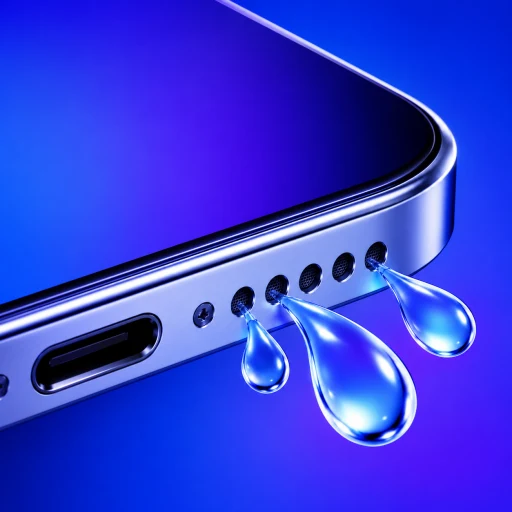
What problem can water ejection address?
A speaker produces sound by moving a diaphragm. If fresh-water droplets sit near that moving surface or obstruct the grille, a controlled sound can help move them outward. Gravity and a downward-facing opening give displaced water somewhere to go.
This is a narrow mechanical job. Water ejection is most plausible when the speaker still works, the audio changed immediately after water exposure, and the symptom improves as droplets move or evaporate.
Why do results vary?
Phones contain more than one audio output. The bottom loudspeaker handles most media; the top receiver handles calls at your ear. A web sound or shortcut may drive only the normal media route. It can appear to fail when the wet component is actually the earpiece.
Results also depend on the liquid. Fresh water can evaporate without the same residue as salt water, pool water, milk, coffee or soda. Sound may move contaminated liquid but cannot remove salts, sugars, oils or dirt left behind.
What does a useful test look like?
Use one controlled sequence rather than many unrelated tones. Remove the case, disconnect cables and Bluetooth outputs, identify the affected speaker, and point it downward over a lint-free cloth. Play familiar audio at a fixed moderate volume before and after the sequence.
Look for a meaningful change:
- speech becomes easier to understand;
- volume returns without increasing the setting;
- crackling or muffling decreases;
- droplets appear at the opening;
- the affected output responds while the other remains normal.
No visible spray does not automatically mean failure, and visible droplets do not prove the rest of the phone is dry.
What can make the method fail?
Water ejection depends on a functioning speaker and correct routing. It may not help when audio is going to Bluetooth, the wrong output is selected, the grille is blocked by dirt, the speaker is electrically or physically damaged, or the sound cannot be reproduced normally.
It also cannot solve a wet charging connector. Apple advises disconnecting cables and allowing airflow rather than using heat, compressed air, rice or objects in the port. Follow Apple’s liquid-detection guidance for connector problems.
When should you stop testing?
One complete run followed by drying time is a reasonable first test. A second can be useful if the first moved droplets and produced clear improvement. Stop when repeated playback changes nothing, distortion worsens, the speaker is silent or the phone has charging, display, power, heat or camera symptoms.
Apple notes that wet-speaker performance may remain degraded until water evaporates. Its wet-iPhone guidance should govern the broader device response. Water Eject is evidence of one tool doing one job—not proof that the incident is resolved.
Questions about whether water ejection works
How can I tell whether Water Eject helped?+
Compare the same familiar audio before and after one sequence at the same volume. Clearer speech, restored loudness or visible droplets are useful signs, but they do not prove the inside of the phone is dry.
Why does Water Eject work for one speaker but not another?+
The bottom loudspeaker and top receiver are separate outputs. A sound routed to the bottom speaker may not drive the earpiece, and different cavities can hold water differently.
Does Water Eject remove all water from an iPhone?+
No. It acts only through a working audio output and cannot reach moisture elsewhere inside the device or connector.
What if nothing changes after the sound?+
Confirm output, volume and positioning, then allow drying time. Stop repeating tones if there is no improvement, the speaker is silent, the liquid was contaminated or other phone problems are present.