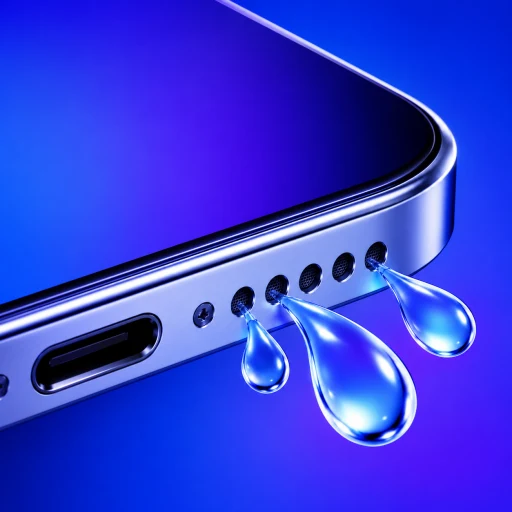
What should you do in the first five minutes?
Move calmly and keep the response simple:
- Disconnect charging cables, headphones, adapters, and other accessories.
- Remove the case so liquid is not held against the phone.
- Wipe the exterior with a soft, lint-free cloth.
- Hold the connector downward and gently tap the phone against your hand to remove excess liquid from the connector area.
- Leave the iPhone in a dry area with airflow.
- Do not connect a cable or accessory while the phone is wet.
Apple’s current liquid-exposure guidance says splash, water, and dust resistance are not permanent conditions and can decrease with wear. A water-resistance rating is not permission to keep using or charging a wet phone.
What should you avoid?
Do not use a hair dryer, heater, oven, or other external heat source. Do not use compressed air. Do not insert paper towel, cotton swabs, pins, or other objects into the charging connector. Do not bury the phone in rice.
Apple’s liquid-detection instructions specifically warn against heat, compressed air, foreign objects, and rice. These methods can introduce particles, stress components, or move moisture in an uncontrolled way.
When can you charge the iPhone again?
Wait until the device and connector are dry. Apple’s general wet-iPhone guidance advises allowing at least five hours before wired charging or connecting an accessory. If the phone shows a liquid-detection alert, disconnect the cable and follow the alert-specific process; Apple notes that a connector can take up to 24 hours to dry fully.
Do not repeatedly override a liquid alert for convenience. Emergency override exists for exceptional circumstances, but charging a wet connector can corrode pins and cause permanent damage. Wireless charging still requires the back of the phone to be dry.
When should you use a water-eject sound?
Only after the basic safety steps, and only if the phone otherwise works. If music or calls sound muffled because water is near the speaker or receiver, a controlled sound sequence may help move droplets from that cavity.
Remove the case, confirm the affected output, point it downward, and run one sequence. Wipe away droplets and return the phone to a dry area with airflow. Clearer audio does not mean the charging connector or internal components are dry.
What changes with salt water, pool water, or drinks?
Fresh water can evaporate without leaving the same residue as seawater, chlorinated pool water, milk, coffee, soda, or soap. Contaminated liquids can leave salts, sugars, oils, or particles around openings and components.
Apple says that if a liquid other than water splashes on supported iPhone models, the affected exterior area can be rinsed with tap water and then wiped with a soft, lint-free cloth. Follow the current guidance for your exact device and avoid presenting a speaker tone as a complete remedy for residue.
How do you know when the problem is bigger than the speaker?
A muffled but functioning speaker after a brief splash is different from a phone with multiple systems affected. Stop speaker-only troubleshooting and consider service when you notice:
- charging failure or repeated liquid alerts after drying;
- unexpected heat, shutdowns, restarts, or rapid battery drain;
- display changes, camera fogging, Face ID problems, or touch failure;
- no speaker output, severe crackling, or worsening distortion;
- symptoms that persist after the phone has had adequate drying time.
Water Eject is useful only inside its boundary: helping move water from a working audio cavity. A calm response includes knowing when not to press play again.
Questions about a wet iPhone
Should I turn off a wet iPhone?+
If the exposure was deep, prolonged, contaminated, or followed by abnormal heat, restarts, display changes or other faults, stop using the phone and seek appropriate device-care advice. At minimum, disconnect all cables and do not charge it while wet.
Should I put the iPhone in rice?+
No. Apple explicitly advises against putting an iPhone in rice because small particles can damage the device. Use a dry area with airflow instead.
Can I use a hair dryer or compressed air?+
No. Apple advises against external heat and compressed air. Heat can damage components, and forced air can move moisture or debris further into openings.
When can I use Water Eject?+
Use it only when the phone functions normally enough to play sound and the remaining issue is a wet speaker or earpiece. It is not a treatment for internal moisture, charging failure or broader liquid damage.