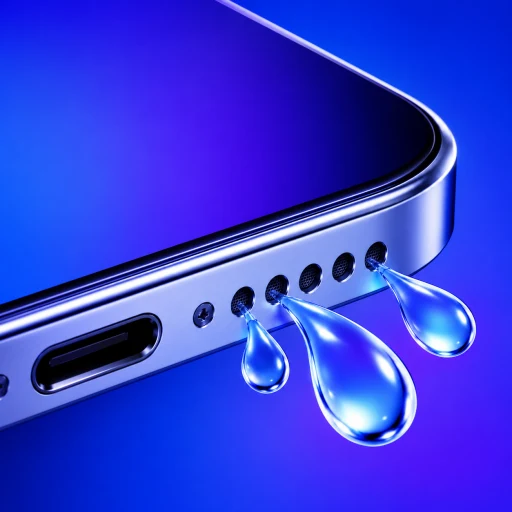
Why do low frequencies move visible water?
Frequency describes how many times a sound wave cycles each second. Lower tones generally ask a speaker diaphragm to move more slowly and visibly than speech or high-pitched alerts. That movement can disturb droplets near the diaphragm and grille.
The useful effect is physical displacement. It is not a special frequency that attracts water. Gravity, cavity geometry, surface tension and the path through the grille all influence whether a droplet moves outward.
Why is there no universal best number?
Phone speakers differ in size, tuning, enclosure design and frequency response. The bottom loudspeaker and top receiver are also different components. A frequency reproduced strongly by one output may be weak or distorted on another.
Droplets do not sit in identical positions. A continuous note that works in one incident may do little in another. That is why a controlled sequence can pulse, pause and sweep rather than depending on one endless tone.
Why does Water Eject use 165 Hz?
Water Eject’s automatic mode centers on pulsed 165 Hz bursts and combines them with resonance sweeps and synchronized vibration. The design creates repeated diaphragm movement while changing the pattern over roughly one minute.
The number is a product parameter, not a guarantee. The automatic sequence remains useful because it combines frequency, timing and haptics in a repeatable workflow. Manual mode exists for deliberate testing, not because a worried user should hunt for a magic value.
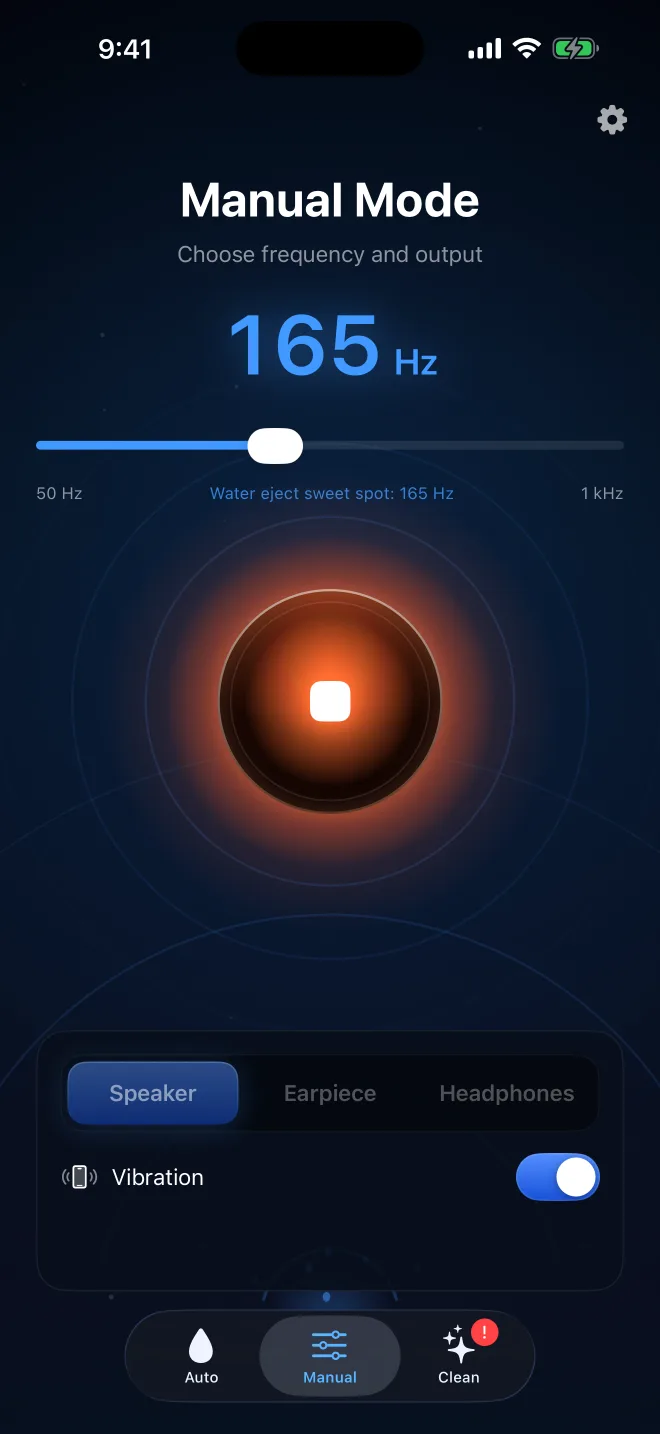
How should you use manual frequency controls?
First choose the correct output and point it downward. Start at a moderate volume. Change frequency gradually and listen for clean reproduction rather than maximum loudness. If the speaker rattles, scrapes or crackles more harshly, stop.
Use one short controlled test, wipe away droplets and allow airflow. Do not sweep the entire range repeatedly. A speaker that cannot reproduce the selected tone normally will not become more effective just because the number is lower.
What matters besides frequency?
- Output: the tone must reach the wet speaker or receiver.
- Position: the opening should give displaced water a downward path.
- Volume: strong enough for movement, not so high that distortion dominates.
- Pattern: pulses and pauses can be more controlled than continuous playback.
- Liquid: residue from salt, chlorine or drinks remains after water moves.
- Time: remaining moisture may need to evaporate.
Apple notes that speaker performance can remain degraded until water evaporates. Follow its wet-iPhone guidance alongside any audio sequence.
When should you stop changing frequencies?
Stop if no ordinary sound plays, the crackle worsens, the phone has other liquid symptoms or one complete sequence produces no meaningful change. At that point, output routing, drying, contamination, blockage or service evaluation is more relevant than another frequency.
Questions about water-eject frequency
Is 165 Hz the best water-eject frequency?+
It is the center frequency used by Water Eject’s automatic sequence, not a universal optimum for every speaker. Hardware, cavity shape, output and droplet position vary.
Is a lower frequency always better?+
No. Very low tones may reproduce poorly on a small speaker, while excessive volume can add distortion. Use a controlled range the speaker can reproduce cleanly.
Should the earpiece use a higher frequency?+
Not automatically. The top receiver differs from the bottom speaker, but explicit output routing and comfortable playback matter more than assuming higher frequency is safer or more effective.
Can I sweep frequencies manually?+
Yes, with a tool designed for controlled manual playback. Start conservatively, change one variable at a time and stop if crackling or mechanical distortion worsens.