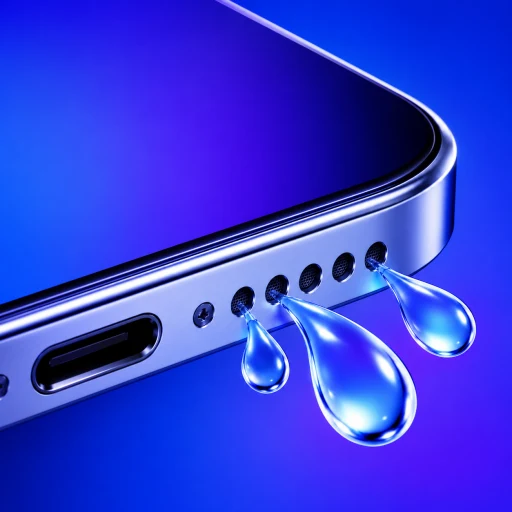
Why pulsed bursts instead of one long tone
A continuous tone pushes against a droplet at a steady pressure, and a droplet held by surface tension can simply sit there and absorb it. Short bursts do something different: each burst starts and stops the diaphragm's movement, and the repeated acceleration breaks the droplet's grip on the surface it is resting against.
That is why the sequence here alternates. Eight bursts at 165 Hz work on the droplet, then a sweep from 150 Hz to 330 Hz passes through the range where different cavity shapes resonate, in case your phone's speaker chamber peaks somewhere other than 165 Hz. Then the pattern repeats.
165 Hz is not a magic number. It is roughly where a phone speaker's diaphragm has the largest excursion, and 150–330 Hz is the band around it that stays useful across different phones.
Which speaker is actually wet
Almost every phone has at least two audio outputs: the loudspeaker at the bottom edge, which plays music and video, and the earpiece at the top, which you hold against your ear on a call. They are separate holes into separate cavities, and water gets into them separately.
This page plays through whatever output your browser is using, which is the loudspeaker. If calls sound muffled but music is fine, the water is in the earpiece, and a browser tone cannot reach it — that routing is only available to an app that can request it.
A quick test: play music. If music is clear and only calls are muffled, the wet output is the earpiece, not the loudspeaker.
What a result looks like — and what it doesn't
Sometimes you will see droplets appear at the grille. More often you will not see anything, and the only evidence is that the sound gets clearer. Both are normal.
Judge it with the same audio at the same volume, before and after. What counts:
- speech becomes easier to understand;
- loudness returns without turning the volume up further;
- crackling or a muffled quality decreases;
- the affected output improves while the other one stays normal.
No visible spray does not mean it failed, and visible droplets do not mean the inside of the phone is dry.
When to stop running it
Three runs is the limit worth trying. If nothing has improved by then, more repetitions will not help — the problem is not a droplet sitting on the diaphragm.
Stop immediately, and do not keep playing tones, if any of this is true:
- the speaker makes no sound at all, or a new rattling or buzzing appeared;
- the liquid was salt water, pool water, or anything with sugar, milk or oil in it;
- the phone was submerged, or it is behaving strangely in other ways;
- the sound was fine and then got worse while you were running tones.
Contaminated liquid leaves residue behind after the water has gone. Sound cannot remove salt, sugar or oil, and driving a speaker hard through residue is not doing you a favour.
Why the tone stops at 1 kHz
The tool asks you to turn the volume to maximum, because the diaphragm needs to move as far as it can. That instruction is only responsible if the frequencies stay low. Loud high-frequency tones are the ones that damage hearing fastest, so nothing on this site goes above 1 kHz — the same ceiling the app enforces in its audio engine.
It also means you should never do this with headphones on. A wet phone frequently gets stuck thinking headphones are connected, so check where the audio is actually going before you raise the volume.
Questions about the water eject tone
How many times can I run the tone?+
Up to three times, with a listen in between. If there is no improvement after three runs, the problem is not a droplet the tone can move, and repeating it further will not change that.
Can the tone damage my speaker?+
Playing a loud low tone for under a minute is within what a phone speaker is built to do. What is not advisable is running it for many minutes back to back, or running it while the liquid contained salt or sugar, because the diaphragm is then working against residue.
Can I use headphones so it is quieter?+
No. Headphones defeat the point — the tone has to reach the wet speaker — and a loud tone directly against your eardrum is the one genuinely dangerous way to use this. Take them out.
Does this work on Android as well as iPhone?+
Yes. The tone is generated by your browser, so it plays on any phone with a working speaker. Nothing about the physics is specific to one manufacturer.
Nothing plays when I press the button. Why?+
Check the ringer or silent switch, the media volume, and whether Bluetooth has quietly connected to a speaker or a car. If the phone is stuck in headphone mode after water, the audio may be routing to an output that is not there — the headphone-mode check covers that.